
Why Kenya’s Car Hire and Transport Industry Is Ready for a Digital Marketplace
By Vinius M Muthii | October 05, 2026
Kenya has no shortage of vehicles, transport operators or demand. What remains fragmented is the infrastructure connecting them. Digital marketplaces could change how people hire cars, businesses find trucks, cargo owners access transport capacity and vehicle owners keep their assets productive.
Kenya's transport economy is enormous, but much of the way vehicles, customers, cargo and transport providers find one another remains surprisingly fragmented.
A traveller looking for a rental vehicle may still depend on referrals, phone calls, WhatsApp messages or several individual operators. A business that urgently needs a truck may call multiple transporters before finding one with the right vehicle, capacity, location and availability.
Meanwhile, a fleet owner may have vehicles sitting idle even though somewhere else there is a customer actively searching for exactly that capacity.
The problem is not necessarily a shortage of vehicles or demand.
It is often a market coordination problem.
Kenya already has the ingredients for a large digitally connected mobility economy:
- Vehicle owners
- Car-hire businesses
- Car dealers
- Fleet operators
- Truck owners
- Logistics companies
- Manufacturers and distributors
- Importers and exporters
- SMEs
- Corporate customers
- Millions of individual consumers
What remains fragmented is the infrastructure connecting these participants efficiently.
That creates an opportunity for a new generation of digital mobility marketplaces — and it is one of the opportunities Salvin Cars is being built to address.
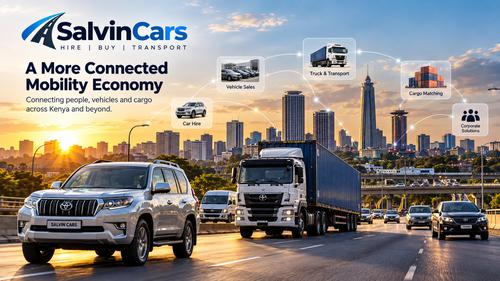
Salvin Cars connected mobility marketplace in Kenya
Transport Is Already One of Kenya's Major Economic Engines
The scale of Kenya's transport economy makes the opportunity difficult to ignore.
According to the Kenya National Bureau of Statistics (KNBS), transportation and storage output reached approximately KSh 3.48 trillion in 2024, with road transport accounting for about 75.1% of the sector's output.
The sector continued growing in 2025, with Transportation and Storage expanding by approximately 3.7%.
Road transportation alone generated an estimated KSh 2.57 trillion in output in 2025, including approximately:
| Segment | Estimated 2025 Output |
|---|---|
| Passenger road transport | KSh 1.50 trillion |
| Freight road transport | KSh 1.08 trillion |
| Total road transport | KSh 2.57 trillion |
Behind those numbers are millions of individual movements: people travelling, businesses delivering goods, companies hiring vehicles, distributors moving inventory and trucks carrying cargo between farms, factories, warehouses, ports, towns and cities.
Kenya's vehicle ecosystem is expanding too.
KNBS recorded 142,994 newly registered motor vehicles in 2025, compared with 140,703 in 2024. Registrations of lorries and trucks increased by approximately 21.8%, while trailer registrations increased by more than 30%.
These numbers demonstrate something important:
Kenya does not lack transport assets. The next opportunity is making those assets easier to discover, access and utilise.
The Fragmentation Problem
Consider three common situations.
A customer needs a vehicle
A traveller lands in Nairobi and wants a reliable SUV for four days.
They may need to search through different websites, social-media pages, referrals and WhatsApp contacts before finding an appropriate vehicle.
A business needs transport
A construction company needs a truck to move materials from Nairobi to Nakuru.
Someone may have to call several transporters to determine who has the appropriate truck available on the required date.
A transporter needs cargo
A truck owner completes a delivery from Mombasa to Nairobi but has no confirmed cargo for the return journey.
The truck exists.
The demand may exist.
But the two sides may never find one another.
That is the fragmentation problem.
It creates inefficiencies across the industry:
- Customers spend time searching and comparing providers manually.
- Vehicle owners may have expensive assets sitting idle between bookings.
- Transporters struggle to maintain consistent fleet utilisation.
- Cargo owners depend heavily on existing transporter networks.
- Dealers continuously spend on customer acquisition.
- Smaller operators struggle to reach customers outside their immediate networks.
- Businesses may have difficulty accessing additional transport capacity during periods of high demand.
Technology can reduce these information gaps.
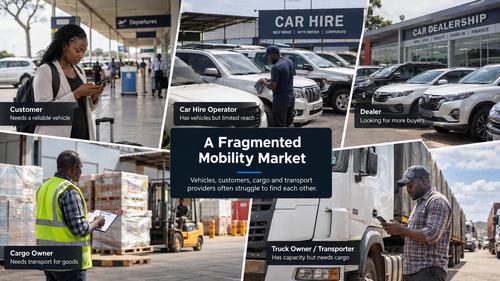
Fragmented car hire and transport market in Kenya
From Vehicle Ownership to Vehicle Utilisation
One of the most important changes digital marketplaces can create is a shift in focus from simply owning transport assets to maximising their utilisation.
A vehicle represents significant capital.
Whether it is a Toyota used for car hire, a corporate van, a pickup or a heavy commercial truck, its economics improve when it spends more time generating revenue.
An idle vehicle still carries costs:
- Insurance continues.
- Financing repayments continue.
- Licensing and compliance obligations remain.
- Depreciation continues.
- Maintenance costs eventually arise.
But revenue stops.
This creates an important business opportunity.
The next generation of mobility companies does not necessarily need to own thousands of vehicles.
A different model is possible:
Build the digital infrastructure that helps thousands of independently owned vehicles find demand.
That is the marketplace opportunity.
The Car-Hire Market Can Become More Connected
Kenya already has numerous car-hire businesses, individual vehicle owners and fleet operators.
The challenge for customers is often not whether vehicles exist.
It is discovery, comparison and trust.
A customer typically wants answers to several questions:
- Which vehicles are currently available?
- What does the actual vehicle look like?
- What is the daily or monthly rate?
- Is a driver available?
- Is self-drive available?
- Can the vehicle travel outside Nairobi?
- What documentation is required?
- Is the provider verified and reliable?
- Can a corporate customer hire multiple vehicles?
- What happens if there is a problem during the booking?
A well-designed digital marketplace can bring structure to these questions.
Instead of searching through numerous independent providers, customers could discover multiple vehicle categories, compare options, submit booking requirements and interact with verified providers through one ecosystem.
The platform does not necessarily need to own the vehicles.
The model becomes:
Vehicle owners provide supply.
Customers provide demand.
Technology provides discovery, coordination and trust.
That is fundamentally different from creating another traditional car-hire company.
It is about building infrastructure for the broader car-hire ecosystem.
The Same Principle Extends to Trucks and Cargo
The opportunity becomes even more significant when commercial transport enters the picture.
Kenya's economy continuously moves:
- Agricultural produce
- Construction materials
- Manufactured goods
- Imports and exports
- Retail inventory
- Industrial products
- FMCG products
- Machinery and equipment
The Port of Mombasa handled approximately 45.6 million metric tonnes of cargo in 2025, according to KNBS.
Every shipment eventually creates another question:
How does the cargo move from one point to another?
Road transport remains critical to answering that question.
Yet freight matching can still depend heavily on relationships, brokers, phone calls and established transporter networks.
A digital marketplace could make the process more structured.
A cargo owner could specify:
- Pickup: Mombasa
- Destination: Nairobi
- Cargo: Containerised goods
- Weight: Specified tonnage
- Truck required: Appropriate commercial vehicle
- Pickup date: Required date/time
- Special requirements: Where applicable
The platform could then identify transport providers with relevant capacity and availability.
The marketplace becomes a bridge between two fragmented groups:
Cargo Demand ? Digital Marketplace ? Available Transport Capacity
Cargo owners potentially gain access to a wider supply network.
Transporters potentially gain access to additional jobs.
And better matching can improve fleet utilisation.
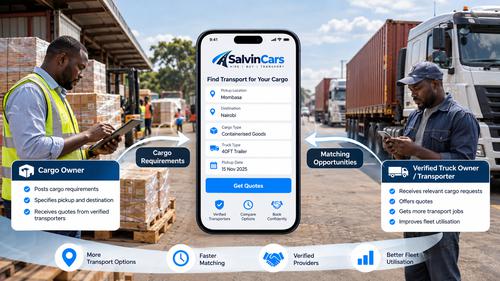
Digital cargo and truck matching marketplace
The Empty-Return Problem Is Particularly Interesting
Consider a truck transporting goods:
Nairobi ? Mombasa
The truck owner earns revenue on the outbound journey.
But if that truck returns empty, the vehicle still consumes:
- Fuel
- Driver time
- Tyres
- Maintenance capacity
- Road expenses
- Asset time
without generating equivalent return-trip revenue.
Now consider another business in Mombasa that needs cargo transported to Nairobi around the same time.
The economic opportunity already exists.
What's missing is information.
A sufficiently connected digital freight marketplace could potentially identify:
| Available Capacity | Transport Demand |
|---|---|
| Truck arriving in Mombasa | Cargo waiting in Mombasa |
| Truck needs return journey | Cargo needs transport |
| Destination: Nairobi | Destination: Nairobi |
| Available capacity | Required capacity |
Instead of:
Nairobi ? Mombasa ? Empty Return
the opportunity becomes:
Nairobi ? Mombasa ? New Cargo ? Nairobi
This is commonly associated with improving backhaul utilisation.
Technology cannot eliminate all the operational complexity involved in freight transportation, but it can improve the probability that unused capacity finds suitable demand.
Across thousands of commercial vehicles, even modest improvements in utilisation could create significant economic value.
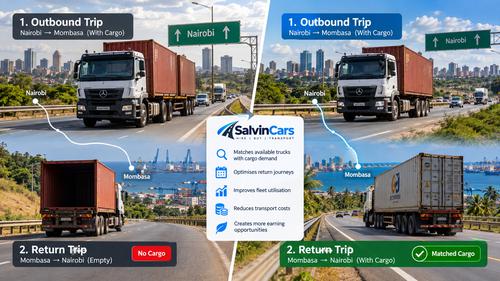
Truck backhaul cargo matching between Nairobi and Mombasa*
Trust Will Determine Which Platforms Win
Building a marketplace interface is relatively easy.
Building a marketplace people trust is considerably harder.
Mobility platforms therefore cannot focus only on listings.
They need mechanisms for verification.
Depending on the service, verification could include:
Vehicle and Provider Verification
- Vehicle documentation
- Ownership information
- Insurance information
- Vehicle inspection information
- Driver documentation
- Business verification
Customer and Transaction Controls
- Customer verification
- Booking records
- Payment records
- Transaction history
- Ratings and reviews
- Dispute-management procedures
Commercial Transport Information
For trucks and cargo, additional information may include:
- Vehicle capacity
- Truck/body type
- Permitted cargo
- Operating routes
- Driver information
- Compliance documentation
- Availability
The winning mobility platforms will therefore not simply answer:
"Who has a vehicle?"
They will increasingly need to answer:
"Who has the appropriate, available and verified vehicle for this requirement?"
That is a significantly more valuable question.
Data Could Become One of the Industry's Most Valuable Assets
Once transactions begin moving through digital platforms, another transformation becomes possible:
Data.
Over time, a mobility marketplace can begin answering questions that are difficult to see in a fragmented offline market.
Demand Intelligence
- Which vehicles receive the most enquiries?
- Which vehicle categories experience supply shortages?
- Which months produce higher car-hire demand?
- Which locations generate the most bookings?
Logistics Intelligence
- Which routes experience the highest freight demand?
- Where does truck capacity frequently go unused?
- Which routes generate frequent empty returns?
- What truck types are most frequently requested?
Provider Intelligence
- Which providers consistently complete jobs successfully?
- Which vehicles have the highest utilisation?
- Which customers generate recurring transport requirements?
- Which providers receive the strongest customer ratings?
This information could eventually support:
Better pricing ? Better demand forecasting ? Better fleet planning ? Better investment decisions
A truck owner considering purchasing another vehicle could make that decision using actual demand information.
A car-hire operator could identify which vehicle categories customers request most frequently.
A dealer could understand what buyers are searching for.
A logistics company could anticipate demand on particular routes.
At that point, the marketplace evolves from merely facilitating transactions into something potentially much more valuable:
Mobility intelligence infrastructure.
Payments and Financial Services Can Follow
Once verified customers, vehicles, transactions and payment histories exist within the same ecosystem, opportunities extend beyond matching.
Potential services could eventually include:
- Digital payments
- Vehicle financing
- Insurance integration
- Fleet financing
- Maintenance partnerships
- Fuel partnerships
- Controlled or escrow-style payments where appropriate
- Business credit
- Asset leasing
- Transaction-based financing
This is particularly interesting because many transport operators own productive assets but may lack structured digital histories demonstrating how those assets perform commercially.
A digital marketplace can gradually create those histories.
With appropriate partnerships, risk controls and regulatory frameworks, transaction data could eventually help financial institutions better understand:
- Vehicle utilisation
- Revenue consistency
- Transaction volumes
- Customer demand
- Commercial performance
That could create an entirely new relationship between mobility platforms and financial institutions.
Where Salvin Cars Fits
This is the broader opportunity behind Salvin Cars.
The vision extends beyond creating another website where vehicles are advertised.
Salvin Cars is being developed around an asset-light mobility marketplace model, connecting participants across the automotive and transport ecosystem.
1. Car Hire
Connecting customers requiring vehicles with independent vehicle owners and fleet operators.
2. Vehicle Sales
Creating an additional digital distribution channel through which vehicle owners and dealers can connect with prospective buyers.
3. Truck and Commercial Transport
Connecting businesses and cargo owners requiring transport with available truck and fleet capacity.
Rather than Salvin purchasing every vehicle available through the ecosystem, independent owners and businesses provide the underlying assets.
Salvin provides the digital connection between supply and demand.
The longer-term customer journey could increasingly resemble:
Search ? Discover ? Compare ? Request ? Match ? Transact ? Review ? Return
all within a more connected mobility environment.
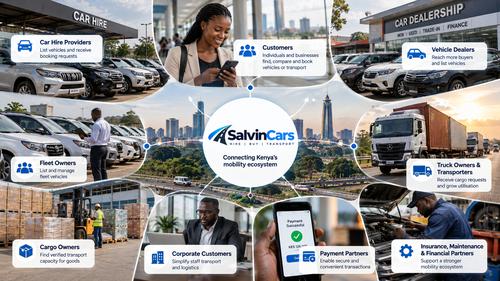
Salvin Cars mobility ecosystem connecting transport partners*
Why the Asset-Light Model Matters
Traditional transport businesses can be extremely capital intensive.
Consider the difference.
Traditional Fleet Model
To expand from:
10 vehicles ? 50 vehicles ? 100 vehicles
the business may need to finance or purchase each additional vehicle.
Capital requirements increase significantly as the fleet expands.
Marketplace Model
If:
100 independent owners × 1 vehicle each = 100 available vehicles
the marketplace can potentially create access to a substantial vehicle network without purchasing all 100 assets itself.
The same principle applies to trucks.
That does not mean marketplaces are easy businesses to build.
Capital and effort are still required for:
- Technology
- Customer acquisition
- Provider acquisition
- Verification
- Operations
- Customer service
- Marketing
- Compliance
- Partnerships
- Trust and reputation
But capital can increasingly be directed toward building the network and technology, rather than primarily purchasing transport assets.
That creates the possibility of a more scalable model.
Network Effects Could Become the Real Competitive Advantage
Digital marketplaces become particularly powerful when supply and demand grow together.
The cycle can develop like this:
- More vehicle and fleet owners join
- Customers receive greater selection and availability
- Better selection attracts more customers
- More customers create more transactions
- More transactions create greater earning opportunities for providers
- Greater earning opportunities attract more providers
- The cycle repeats
The same dynamic can occur between truck capacity and cargo demand.
More Supply ? Better Choice ? More Demand ? More Transactions ? Greater Provider Earnings ? More Supply
That is the network effect Salvin Cars ultimately needs to build.
But technology alone will not create it.
Relationships will.
That is why partnerships with car-hire businesses, vehicle owners, dealers, fleet operators, truck owners, logistics companies, manufacturers, distributors, importers, exporters and corporate customers are so important during the early stages.
The marketplace must build both sides simultaneously.
Kenya Is a Natural Launch Market
Kenya provides an interesting environment for this type of mobility platform.
The country combines:
- A large road-transport economy
- Widespread mobile-money adoption
- A developed technology ecosystem
- Significant domestic trade
- Regional trade corridors
- A major East African port
- A large entrepreneurial transport sector
- Growing vehicle ownership and commercial fleets
Kenya's importance also extends beyond its domestic economy.
Cargo entering through the Port of Mombasa supports regional trade corridors connecting Kenya with neighbouring economies.
A mobility platform that successfully proves its model locally could therefore have opportunities to explore other East African markets over time.
The long-term question is not simply:
Does Kenya need another car-hire company?
or:
Does Kenya need another logistics company?
A more interesting question is:
Does East Africa need better digital infrastructure connecting mobility demand with independently owned transport assets?
The opportunity increasingly suggests that it does.
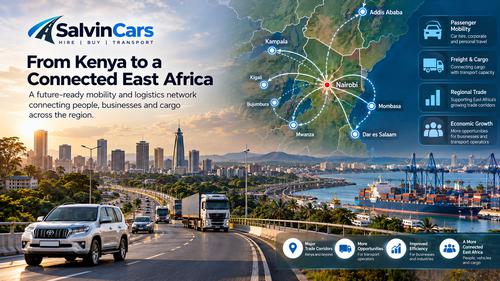
Kenya and East Africa digital mobility and logistics network.*
From Fragmented Operators to Connected Ecosystems
Many industries follow a similar technological evolution:
- Independent providers operate separately.
- Directories make providers discoverable.
- Marketplaces make providers comparable.
- Digital transactions make services easier to purchase.
- Data makes the ecosystem more intelligent.
- Financial services deepen the ecosystem.
Transport is moving through the same transformation.
The companies that ultimately succeed will not necessarily be those that own the largest number of vehicles.
Some may be those that build the strongest networks connecting:
Vehicles + Owners + Customers + Cargo + Businesses + Payments + Data
That is the opportunity Salvin Cars is pursuing.
The future of mobility may therefore be less about asking:
"Who owns the vehicle?"
and increasingly about asking:
"How efficiently can technology connect the right vehicle to the right demand at the right time?"
For Kenya's fragmented car-hire and transport market, answering that question could unlock significant value.
About Major Innovation
Major Innovation explores technology, digital transformation, investment and emerging business models shaping Africa's next generation of enterprises.
About Salvin Cars
Salvin Cars is an emerging Kenyan mobility marketplace focused on connecting customers and businesses with vehicle owners, car-hire providers, dealers, fleet operators and commercial transport capacity.
Its broader vision is to use technology to make vehicle discovery, mobility services and transport matching more accessible, efficient and connected.
Never miss Technological Updates
Subscribe to our Newsletter
Join our Community
Follow us on social media to stay connected and engage with our vibrant tech community: