
Why Property Management in Kenya Is Ready for a Technology-Driven Transformation
By Vinius M Muthii | September 14, 2026
Kenya's real estate conversation often focuses on construction.
How many homes are being built?
Where are property prices rising?
Which locations offer the best investment opportunities?
But there is another part of the housing economy that receives considerably less attention:
What happens after a property has been built, purchased, and handed over?
Someone still has to find tenants.
Someone has to manage enquiries.
Rent needs to be collected.
Payments need to be reconciled.
Tenants need to be onboarded.
Vacant units need to be marketed.
Maintenance issues need to be communicated.
Property owners need visibility into what is happening with their investments.
And when these activities are fragmented across phone calls, spreadsheets, notebooks, WhatsApp conversations, agents and separate payment channels, property ownership can become considerably more complicated than it needs to be.
This is where I believe one of the next important opportunities in Kenya's real estate industry exists.
The future of property management will not simply be about managing buildings. It will increasingly be about managing information, payments, relationships and property performance through technology.
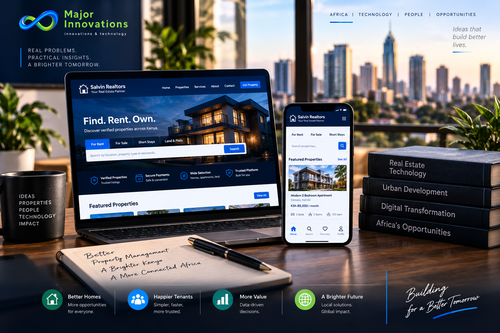
Kenya Is Already a Rental Economy
To understand the opportunity, we first need to understand how important rental housing already is.
According to the Kenya National Bureau of Statistics' analysis of the 2019 Kenya Population and Housing Census, approximately 70.1% of urban households lived in individually rented housing units.
That means rental housing is not a small segment of Kenya's urban economy.
It is one of its foundations.
The more recent 2023/24 Kenya Housing Survey also demonstrates how economically significant housing is to households.
Nationally, renting households spent approximately 36.9% of household expenditure on rent.
Among urban renting households, that figure increased to approximately 38%.
For millions of households, therefore, rent is one of the largest recurring financial relationships they maintain.
Yet the infrastructure surrounding that relationship can still be remarkably fragmented.
A tenant may discover a property through one channel.
Contact an agent through another.
Pay through another.
Receive confirmation somewhere else.
Report maintenance issues through WhatsApp.
And eventually leave with very little structured digital history connecting those interactions.
The opportunity is not simply to digitize rent payments.
It is to connect the entire rental lifecycle.
Kenya's Housing Challenge Makes Management More Important, Not Less
Kenya's housing challenge is well documented.
World Bank research has estimated a housing deficit exceeding two million units, with historical housing production significantly below the levels required to meet demand.
Rapid urbanization continues to add pressure.
But building more housing creates another question:
Who manages all those properties after they are occupied?
Every new apartment development potentially creates hundreds of future landlord-tenant relationships.
Every investor purchasing a rental apartment becomes a potential property-management customer.
Every new tenant becomes part of an increasingly large rental economy.
Construction solves the supply problem.
Efficient property management solves part of what happens next.
These two opportunities should increasingly be viewed together.
The Digital Infrastructure Is Finally Ready
A technology-driven property-management ecosystem would have been much harder to build fifteen years ago.
Kenya today is very different.
According to the Communications Authority of Kenya, smartphone penetration reached approximately 85.2% by September 2025, while mobile data subscriptions reached approximately 60.2 million.
Mobile broadband accounted for the majority of those connections.
At the same time, Kenya already possesses one of the world's most established mobile-money ecosystems.
Central Bank of Kenya statistics show that registered mobile-money accounts had reached approximately 94.35 million by July 2026.
These numbers matter.
They mean the infrastructure required for digital property management increasingly already exists in people's pockets.
The smartphone can become:
- The property discovery tool
- The booking interface
- The tenant communication channel
- The payment interface
- The landlord dashboard
- The maintenance reporting channel
- The property-management portal
The question is no longer whether Kenyan consumers can interact with property services digitally.
They already interact with much of the economy digitally.
The bigger question is why property management should remain fragmented.
Property Management Is Really an Information Problem
At first glance, property management appears to be about buildings.
In reality, much of it is about information.
A property manager needs to know:
- Which units are occupied?
- Which units are vacant?
- Which tenants have paid?
- Which payments are outstanding?
- Which leases are approaching expiry?
- Which properties are generating enquiries?
- Which maintenance issues remain unresolved?
- What income has a property generated?
- How quickly are vacant units being occupied?
When this information exists across different notebooks, spreadsheets, phones and conversations, decision-making becomes difficult.
Technology changes this by creating a single source of truth.
A landlord should not have to call someone simply to understand whether rent has been received.
A property manager should not have to search through hundreds of messages to determine which tenant reported an issue.
A tenant should not have to wonder whether a payment or booking was received.
Good technology removes uncertainty.
And trust often grows when uncertainty disappears.
Vacancy Is a Technology Problem Too
Property owners understandably focus on rent collection.
But another expensive problem often receives less attention:
vacancy.
An empty unit produces no rental income.
The longer it remains vacant, the greater the opportunity cost to the owner.
Technology can potentially reduce that friction by connecting property management directly with property discovery.
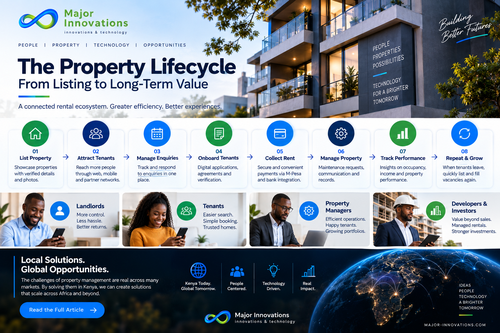
Instead of treating listing and management as separate businesses, an integrated platform can create a continuous cycle:
Property listed
?
Tenant discovers property
?
Enquiry or booking
?
Tenant onboarding
?
Occupancy
?
Rent and relationship management
?
Tenant exits
?
Property automatically returns to market
That is significantly more powerful than simply placing an advertisement online.
It turns property management into a lifecycle.
The Developer Opportunity Is Even Bigger
There is another group that should be paying attention to this transformation:
property developers.
Traditionally, the developer's relationship with an investor may largely end after a unit is sold and handed over.
But consider the investor's next question:
Who will find my tenant and manage this property?
For investment-oriented developments, this creates an opportunity.
Developers could potentially offer buyers something beyond the physical apartment:
a pathway from property ownership to managed rental income.
A technology-enabled property-management partner could support:
- Tenant acquisition
- Property marketing
- Rental onboarding
- Payment administration
- Occupancy monitoring
- Owner reporting
- Ongoing tenant management
This could make investment property more attractive to buyers who want real-estate exposure without becoming full-time property managers themselves.
The future opportunity therefore extends beyond landlord and tenant.
It includes the entire property ecosystem.
This Is the Problem We Are Trying to Solve With Salvin Realtors
These observations are not purely theoretical for me.
They are part of what led us to build Salvin Realtors LTD.
The original idea was straightforward:
Make it easier for people to find properties and easier for landlords to manage them.
But interacting with the market revealed that the problem was larger.
Property discovery was connected to tenant acquisition.
Tenant acquisition was connected to onboarding.
Onboarding was connected to payments.
Payments were connected to communication.
Communication was connected to trust.
And all of those activities ultimately affected property performance.
That realization gradually changed how we thought about the platform.
We were no longer simply building a property website.
We were building infrastructure around the relationship between property owners, tenants and property managers.
From Listings to an Operating System for Rental Property
The first generation of property technology largely helped people answer:
"Where can I find a house?"
The next generation should answer much more:
"How can this property be managed efficiently throughout its entire lifecycle?"
That means bringing together capabilities such as:
- Property discovery
- Digital enquiries
- Tenant onboarding
- Booking
- Payment integration
- Automated communication
- Property administration
- Landlord visibility
- Occupancy management
- Performance insights
The long-term opportunity is not merely another listing marketplace.
It is the possibility of creating a digital operating layer for rental property.
Data Could Become One of the Most Valuable Assets
Once property operations become digital, something else becomes possible.
Data.
Over time, responsibly collected and appropriately protected operational data can help answer questions such as:
- Which locations experience the strongest rental demand?
- What property types attract tenants fastest?
- How long does the average unit remain vacant?
- What amenities influence tenant interest?
- How does rental demand change seasonally?
- Which pricing ranges generate the strongest enquiries?
- Where might future property demand emerge?
This has implications beyond property managers.
Developers could make better decisions.
Investors could understand rental markets more clearly.
Property owners could understand performance.
And platforms could improve recommendations for tenants.
The transformation from manual property management to digital property management therefore eventually becomes a transformation from operations to intelligence.
As someone whose professional work is also grounded in data, this is one of the areas I find particularly interesting.
Kenya Could Build PropTech Solutions for More Than Kenya
There is another possibility worth considering.
Many of the problems facing Kenya's rental market are not uniquely Kenyan.
Landlords across emerging markets deal with:
- Fragmented property administration
- Tenant acquisition
- Rent collection
- Vacancies
- Trust
- Communication
- Limited operational visibility
The details differ between countries.
The underlying problems often do not.
That creates an interesting long-term possibility:
Could technology built to solve property-management challenges in Kenya eventually be adapted for other markets?
Kenya has already demonstrated internationally that locally developed financial technology can influence how the world thinks about digital payments.
There is no reason African entrepreneurs should think only about building technology for African borders.
The correct approach is not to copy foreign products and localize them.
Sometimes it is to solve difficult local problems exceptionally well and then discover that other markets share them.

Why International Investors and Partners Should Pay Attention
The investment opportunity in African technology is often discussed through fintech.
But digitization does not stop with financial services.
Housing is fundamental infrastructure.
Property is a major store of wealth.
Rent is one of the largest recurring household expenses.
Urban populations continue to grow.
Smartphone adoption continues to expand.
Digital payments are already deeply embedded in Kenya's economy.
When those forces intersect, property technology becomes increasingly interesting.
The opportunity may include:
- Property-management platforms
- Rental marketplaces
- Digital payments
- Property analytics
- Tenant services
- Developer partnerships
- Investment-property management
- Cross-border PropTech infrastructure
Not every company pursuing these opportunities will succeed.
Technology alone does not guarantee adoption.
Trust, execution, regulation, customer experience and local market knowledge remain critical.
But the underlying conditions are becoming increasingly difficult to ignore.
Building From Kenya, Thinking Globally
One unexpected lesson from building technology and publishing through Major Innovations has been discovering how easily ideas can cross borders.
Readers do not necessarily care where an article was written.
They care whether the idea is useful.
Software behaves similarly.
A platform may begin by solving a problem in Kutus, Kerugoya, Nairobi or another Kenyan market.
But if the underlying problem exists elsewhere, the knowledge developed while solving it can travel.
That is increasingly how I think about what we are building.
Start locally.
Understand the problem deeply.
Build something useful.
Prove that it works.
Then think bigger.
Not because every Kenyan startup needs to become a multinational company.
But because geography should not automatically define the limits of an idea.
The Future of Property Management Will Be Connected
The future landlord should be able to understand a property portfolio from a phone.
The future tenant should be able to discover, book, pay and communicate through a trusted digital experience.
The future property manager should spend less time reconciling fragmented records and more time improving property performance and customer experience.
The future developer should be able to think beyond selling units toward supporting the long-term investment journey of buyers.
And eventually, data should help every participant make better decisions.
That future will not arrive overnight.
Technology adoption rarely does.
But the foundations are already being built.
Kenya has the rental demand.
It has growing urban centres.
It has widespread mobile connectivity.
It has world-class digital-payment infrastructure.
It has developers, landlords and investors looking for better ways to manage property.
And it has a generation of entrepreneurs willing to build solutions around those challenges.
The opportunity now is to connect those pieces.
Final Thoughts
Property management may not sound like one of technology's most exciting frontiers.
But some of the biggest opportunities in technology come from industries where important processes are still fragmented.
The opportunity isn't simply to replace notebooks with dashboards.
It is to rethink the entire relationship between:
Property.
People.
Payments.
Data.
And trust.
That is the transformation I believe is beginning.
And perhaps some of the most interesting PropTech companies of the next decade will not simply bring global technology into Africa.
Perhaps some will begin here — solving African problems first — and eventually take those solutions to the world.
Explore the Salvin Ecosystem
Learn more about what we are building:
Salvin Realtors:
https://salvinrealtors.com
Salvin Realtors Android App:
Download on Google Play
SalvinCars:
https://cars.salvinrealtors.com
Major Innovations:
https://major-innovations.com
For partnerships, property-management opportunities, technology collaborations or strategic conversations, we are always interested in connecting with people and organizations working toward the future of property, mobility and technology.
About the Author
Vinius M. Muthii is a Data Scientist, Software Developer and Director at Salvin Realtors LTD. He builds technology products across real estate, mobility and data-driven systems while documenting lessons on technology, entrepreneurship, software engineering and innovation through Major Innovations.
His work explores an increasingly important question:
How can technology built in Africa solve local problems exceptionally well — and eventually create value globally?
Subscribe to our Newsletter
Never miss Technological Updates
Subscribe to our Newsletter
Join our Community
Follow us on social media to stay connected and engage with our vibrant tech community: